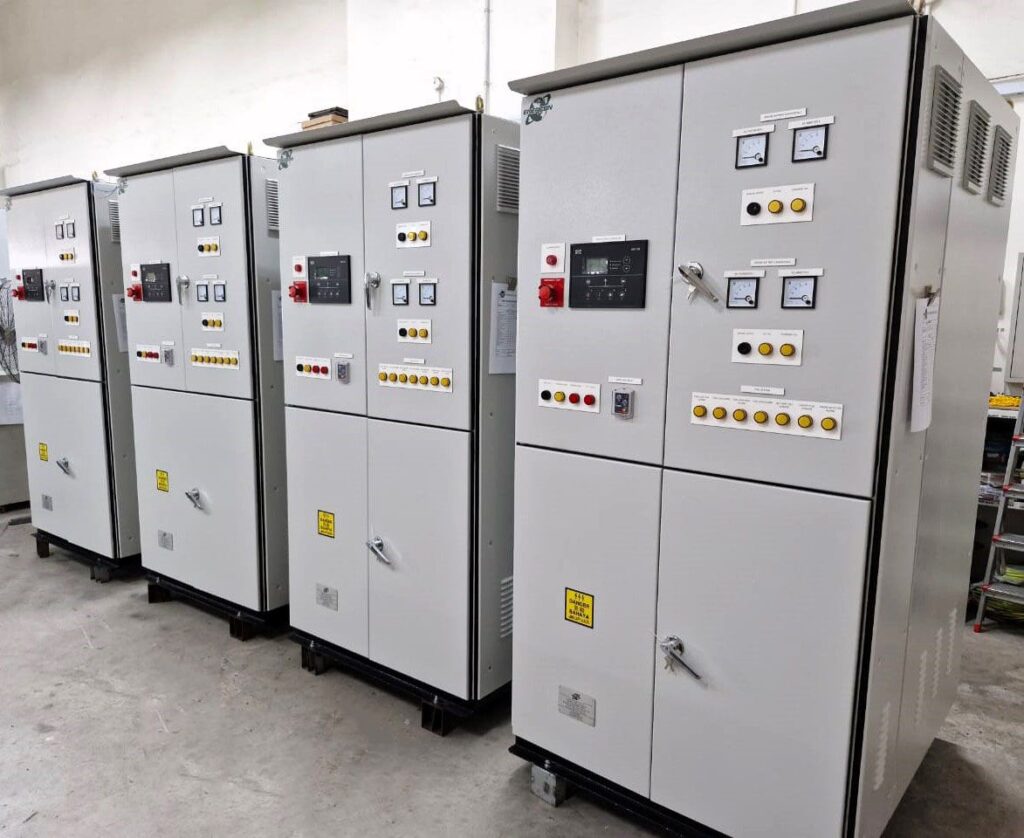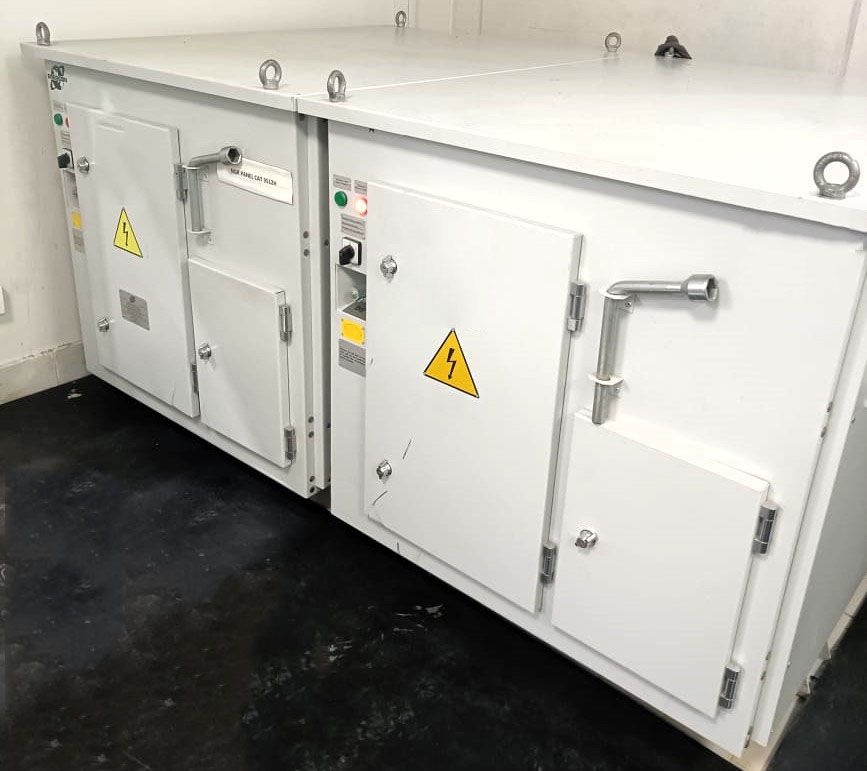
Neutral Grounding Resistor (NGR) limits ground-fault current to a safe value. NGR keeps equipment safe, reduces arc-flash energy, and helps protection relays find faults fast. Many plants use NGR on generators and transformers to protect cables, switchgear, and motors.
You will learn what an NGR is, how it works, and how to size it. You will also see the key ratings to specify and the checks to run during installation and testing. Clear steps and tables will help you make quick decisions.
Engineers, maintenance teams, and procurement teams can use this guide. If you plan a new switchboard or a retrofit, this article will help you pick an NGR that fits your system.
What Is a Neutral Grounding Resistor?
A Neutral Grounding Resistor (NGR) connects a system neutral to ground through a resistor. The resistor limits ground-fault current to a set value. This control protects cables, switchgear, transformers, and generators.
Plants install NGRs on transformer neutrals and generator neutrals. The NGR creates a known fault current, so relays can detect and clear faults quickly. The NGR also reduces arc-flash energy during a single-line-to-ground fault.
Common NGR types
- High-Resistance Grounding (HRG): Limits fault current to about 5–10 A. HRG keeps the process running during a single ground fault while alarms notify the team.
- Low-Resistance Grounding (LRG): Limits fault current to about 50–1000 A. LRG allows selective tripping and reduces damage on medium-voltage systems.
Where NGRs fit
- Generator step-up and unit auxiliaries
- Plant distribution transformers (LV and MV)
- Motor control centers and process lines with long cable runs
How Does a Neutral Grounding Resistor Work?
An NGR creates a controlled path from the system neutral to ground. The path carries current only during a ground fault. The resistor sets the fault current to a value that relays can detect and that equipment can withstand.
Normal condition
- The system is healthy.
- Phase currents flow in the load.
- The NGR carries near-zero current.
- The neutral stays near ground potential.
Single line-to-ground fault
- One phase touches ground.
- Fault current returns through the NGR to the neutral.
- The NGR limits the current to a preset value.
- Protection relays see the residual current or neutral voltage.
- The relay alarms (HRG) or trips (LRG) per the scheme.
Key idea (simple math)
- Target ground-fault current: IfI_fIf (amps).
- System line-to-neutral voltage: VLNV_{LN}VLN (volts).
- Required resistance: R≈VLNIfR \approx \dfrac{V_{LN}}{I_f}R≈IfVLN.
- Thermal duty during a fault: P=If2×RP = I_f^2 \times RP=If2×R (watts).
- Energy for a time-rated NGR: E=P×tE = P \times tE=P×t (joules).
Two practical examples
- HRG example (process continuity):
System 6.6 kV → VLN=6,600/3≈3,810 VV_{LN} = 6{,}600/\sqrt{3} \approx 3{,}810\ \text{V}VLN=6,600/3≈3,810 V.
Target If=5 AI_f = 5\ \text{A}If=5 A.
R≈3,810/5=762 ΩR \approx 3{,}810/5 = 762\ \OmegaR≈3,810/5=762 Ω.
Continuous loss at fault: P=52×762≈19 kWP = 5^2 \times 762 \approx 19\ \text{kW}P=52×762≈19 kW.
The relay raises an alarm; the process can keep running while you locate the fault. - LRG example (selective tripping on MV):
Same voltage. Target If=400 AI_f = 400\ \text{A}If=400 A.
R≈3,810/400≈9.5 ΩR \approx 3{,}810/400 \approx 9.5\ \OmegaR≈3,810/400≈9.5 Ω.
Fault duty: P=4002×9.5≈1.52 MWP = 400^2 \times 9.5 \approx 1.52\ \text{MW}P=4002×9.5≈1.52 MW.
Specify a 10-s or 30-s rating so the resistor can absorb this energy until the breaker clears.
Detection and control
- HRG uses ground-fault relays set to alarm at the chosen current.
- LRG uses time-current coordination so upstream devices trip after downstream devices fail to clear.
- Many systems add a resistor-monitor that trips if the resistor opens.
- Systems without an accessible neutral can add a zig-zag or grounding transformer to create one.
Why this helps
- The NGR keeps fault current within a safe band.
- The NGR improves relay sensitivity and fault location.
- The NGR reduces arc-flash energy during a ground fault compared to solid grounding.
- HRG reduces downtime for a first ground fault; LRG limits damage while allowing selective tripping.
HRG vs LRG: Which Grounding Method Fits Your System?
Quick points
- Fault current: HRG ≈ 5–10 A; LRG ≈ 50–1000 A.
- Operating goal: HRG raises an alarm and keeps the process running; LRG trips the faulted feeder fast.
- Best fit: HRG for LV and some MV with moderate cable length; LRG for larger MV networks and long cables.
- Protection: HRG uses sensitive ground relays; LRG enables clean selective tripping.
- Arc-flash: Both reduce energy versus solid grounding; LRG needs a time rating to absorb short high current.
- Neutral source: Both can use a transformer neutral or a zig-zag grounding transformer.
- Maintenance: HRG needs a prompt fault search after any alarm; LRG depends on a solid coordination study.
High-Resistance Grounding limits ground-fault current to a small value so operations can continue through a first fault. Relays alarm. The team locates and fixes the fault before a second fault occurs. HRG suits lines with frequent starts, drives, and loads that dislike sudden trips. It also suits facilities where product loss from a stop is high.
Low-Resistance Grounding sets a higher fault current so protective devices see a clear signal and trip quickly. The faulted feeder clears, while other feeders stay on. LRG fits medium-voltage distribution with several tiers of protection. It also fits plants that prefer fast isolation over ride-through.
Cable charging current can blur detection on large networks. As a rule of thumb, choose HRG fault current at least 3× the total system charging current at rated voltage. Very long cables push you to LRG because relays need a stronger signal to stay selective and stable.
Protection detail matters. HRG needs sensitive ground relays and a resistor monitor that alarms or trips if the resistor opens. LRG needs time-current coordination so downstream devices clear first. Both schemes need a clear single-line, current targets, and settings that match actual system impedance.
You can use a zig-zag or grounding transformer if the source has no neutral. Connect the NGR to the derived neutral and apply the same selection rules. Verify the transformer kVA and insulation level match the expected ground-fault duty.
Read: Type Tested Panels: Standards, Benefits, and Best Practices
NGR Ratings and What Each Rating Means
System voltage
Rate the NGR for the source line-to-neutral voltage. For a 6.6 kV system, VLN=6,600/3≈3,810V_{LN} = 6{,}600/\sqrt{3} \approx 3{,}810VLN=6,600/3≈3,810 V. The resistor insulation must withstand this voltage and expected overvoltages during faults and switching. Check the specified Basic Insulation Level (BIL) and creepage distance if your site has pollution or humidity.
Fault current rating
Pick a target ground-fault current based on protection goals. HRG uses about 5–10 A for ride-through with alarms. LRG uses about 50–1000 A for fast tripping on MV feeders. The NGR must carry this current for its time rating without damage.
Resistance and tolerance
Compute R≈VLN/IfR \approx V_{LN}/I_fR≈VLN/If. Vendors state a cold resistance tolerance, often ±10%. Resistance rises with temperature, so hot resistance will be higher. Confirm that protection settings account for this change.
Time rating vs continuous duty
HRG is usually continuous-duty at the chosen current. LRG is time-rated, commonly 10 s or 30 s. Match the time rating to breaker clearing time plus margin. Do not oversize time rating without checking thermal limits, because higher ratings increase size and cost.
Energy/thermal capacity
Energy during a fault is E=If2×R×tE = I_f^2 \times R \times tE=If2×R×t. Verify the resistor element, support hardware, and enclosure can absorb this energy and cool down between events. Ask for the maximum shots and required cool time.
Insulation level/BIL
State the BIL that matches your switchgear and system practice. Higher BIL improves surge withstand across the resistor stacks and insulators. This helps in areas with frequent lightning or switching surges.
Temperature rise and element type
Specify the maximum element temperature and surface temperature. Common elements use stainless steel grids or cast alloy. Lower surface temperature reduces burn risk and helps in compact rooms. Add RTDs or thermal switches if your standard requires temperature alarms.
Enclosure rating and material
Choose IP/NEMA class for the location. Indoor rooms often use IP20–IP23. Outdoor sites and dusty plants need IP33–IP54. Coastal or chemical sites benefit from stainless steel 304/316 and powder coating. Provide cable entry direction and gland size to avoid site rework.
Altitude and ambient
Air density falls above 1000 m. De-rate current or increase surface area at higher altitudes. Share site ambient data (min/max °C) so the vendor sets the correct temperature rise limits.
Frequency
State 50 Hz or 60 Hz. The resistor itself is not frequency-sensitive, but auxiliary devices (VTs, monitors) are.
Monitoring and protection
Add a resistor integrity monitor to detect open-circuit or ground leads left disconnected. Use a neutral VT for HRG alarm schemes. Interlock the scheme so maintenance cannot energize the system with the resistor bypassed.
How to Size an NGR (Step-by-Step)
Step 1 — Gather system data
List source voltage (kV), grounding point (transformer or generator neutral), frequency, and short-circuit levels. Note cable lengths and types. Confirm whether a neutral exists or you need a zig-zag/grounding transformer.
Step 2 — Set the grounding method and target fault current
Pick HRG for ride-through of a first ground fault; typical target is 5–10 A. Pick LRG for fast isolation on MV feeders; typical target is 50–600 A. Match the target to relay sensitivity and arc-flash limits for the switchgear.
Step 3 — Calculate resistance
Use line-to-neutral voltage VLN=VLL3V_{LN} = \dfrac{V_{LL}}{\sqrt{3}}VLN=3VLL.
Compute R=VLNIfR = \dfrac{V_{LN}}{I_f}R=IfVLN.
Round to a standard value that relays can detect across temperature changes.
Step 4 — Choose time rating or continuous duty
HRG is usually continuous at the target current. LRG is time-rated (commonly 10 s or 30 s). Let the time rating exceed breaker clearing time plus a small margin.
Step 5 — Check energy and temperature rise
Compute fault energy E=If2×R×tE = I_f^2 \times R \times tE=If2×R×t.
Confirm the resistor element, supports, and enclosure can absorb this energy without exceeding temperature limits. Ask for allowed “shots” and cool-down time.
Step 6 — Verify insulation and BIL
Match the Basic Insulation Level to the switchgear class. Check creepage and clearance for the site environment (humidity, dust, pollution). Confirm the neutral bushing rating.
Step 7 — Account for system charging current (HRG)
Estimate total capacitive charging current Ic≈2πf Ctotal VLNI_c \approx 2\pi f\, C_{total}\, V_{LN}Ic≈2πfCtotalVLN.
Target If≥3IcI_f \ge 3 I_cIf≥3Ic so relays see a clear signal and overvoltage stays within limits on a first fault.
Step 8 — Confirm relay settings and coordination
Set pickup above maximum noise/charging current and below the target fault current. For LRG, coordinate downstream and upstream trip curves so the smallest zone clears first.
Step 9 — Define enclosure and environment
Select IP/NEMA class, material (painted steel or stainless), altitude de-rating, and ambient temperature range. Specify cable entry, gland size, and earthing points.
Step 10 — Document data and nameplates
Record VLL,VLN,If,R,t,EV_{LL}, V_{LN}, I_f, R, t, EVLL,VLN,If,R,t,E, element type, enclosure class, BIL, and monitor functions. Add a single-line diagram and the final relay settings to the dossier.
Worked example — HRG at 6.6 kV
VLN=6,600/3≈3,810 VV_{LN} = 6{,}600/\sqrt{3} \approx 3{,}810\ \text{V}VLN=6,600/3≈3,810 V.
Target If=5 AI_f = 5\ \text{A}If=5 A → R≈762 ΩR \approx 762\ \OmegaR≈762 Ω.
Continuous HRG scheme. Relay pickup at ~3–4 A with alarm and fault-tracking procedure.
Worked example — LRG at 6.6 kV
VLN≈3,810 VV_{LN} \approx 3{,}810\ \text{V}VLN≈3,810 V.
Target If=400 AI_f = 400\ \text{A}If=400 A → R≈9.5 ΩR \approx 9.5\ \OmegaR≈9.5 Ω.
Time rating 10 s. Energy E≈4002×9.5×10≈15.2 MJE \approx 400^2 \times 9.5 \times 10 \approx 15.2\ \text{MJ}E≈4002×9.5×10≈15.2 MJ.
Coordinate feeder relays to clear within the time rating.
Read: Power Transformer Maintenance Strategies Every Industry Should Know
Installation, Commissioning, and Testing Checklist
Pre-installation checks
Verify the single-line diagram. Confirm the grounding point, system voltage, and target fault current. Check the NGR nameplate values for VLNV_{LN}VLN, IfI_fIf, RRR, and time rating. Inspect the shipment for damage, loose hardware, and missing accessories. Review the site ambient, altitude, and enclosure IP class.
Mechanical placement and mounting
Place the NGR on a flat surface with clear airflow. Keep safe clearance around vents and hot surfaces. Use corrosion-resistant anchors. Level the base so the resistor stacks sit evenly. Install warning labels that state surface temperature and shock hazards.
Grounding and bonding
Bond the enclosure to the station ground grid. Use a short, low-impedance earth strap. Clean paint at bond points to bare metal. Torque lugs to spec. Verify continuity from the enclosure to the grid.
Neutral connection
Connect the neutral bushing from the transformer or generator to the NGR input. Keep the lead short and well supported. Use the correct bushing creepage and insulation boots. Do not route the neutral lead with control wiring.
Cable terminations
Crimp lugs with the correct die. Apply anti-oxidant for aluminum. Support cables to remove strain from terminals. Verify phase-to-ground and phase-to-enclosure clearances.
Auxiliary devices and wiring
Install the resistor monitor, neutral VT (for HRG), CTs or core-balance CTs, and temperature switches if provided. Terminate control wires on labeled terminals. Separate power and control wiring. Shield low-level signals where needed.
Protection settings review
Enter relay pickups, delays, and alarms per the coordination study. For HRG, set alarm pickup above maximum charging current and below the target fault current. For LRG, set time-current curves so downstream devices clear first. Record all settings.
Pre-energization tests
- Perform visual inspection and torque check.
- Measure insulation resistance from resistor stacks to enclosure with a megohmmeter (record at 60 s).
- Measure DC resistance of the NGR at ambient (“cold R”). Compare with nameplate tolerance.
- Verify enclosure bonding continuity (<1 Ω typical).
- Check polarity and ratio of VTs/CTs.
- Verify space heaters (if any) and enclosure thermostats.
Functional tests (de-energized and energized)
- Resistor monitor test: Simulate an open circuit and confirm alarm/trip action.
- Relay secondary injection: Inject current/voltage to prove pickups, alarms, and trips.
- Primary injection (preferred for LRG): Inject through the neutral path or use a ground-fault test source on a feeder. Confirm trip times within the NGR time rating.
- HRG overvoltage check: With a test fault applied, verify neutral-to-ground voltage and alarm action.
- SCADA/DCS check: Verify status, alarms, and analog values update on the control system.
Thermal and ventilation check
During a controlled test fault, scan the enclosure with an IR camera if available. Confirm temperature rise stays within limits. Check airflow is unobstructed and louvers are open and clean.
Documentation and as-built records
Capture test sheets for insulation resistance, resistance values, relay settings, trip times, monitor results, and IR images. Update the single-line diagram, cable schedule, and terminal plans. Place copies inside the enclosure in a sealed pouch and archive the digital set.
Safety reminders
Apply lockout-tagout on sources. Prove de-energized before contact. Respect hot-surface warnings; NGR elements can run very hot during faults. Keep covers closed during operation. Do not bypass the NGR or defeat the monitor.
Common mistakes to avoid
Do not connect the neutral lead through a CT window not intended for it. Do not share the neutral path with other returns. Do not set HRG pickup below site charging current. Do not exceed the NGR time rating during tests. Do not leave space heaters unpowered in humid rooms.
Maintenance and Fault Location (Routine, Periodic, and During Alarms)
Routine maintenance (monthly)
Walk around the NGR. Check labels, hinges, and louvers. Confirm space heaters run in humid rooms. Look for rust, dust buildup, and loose hardware. Verify the monitor shows “healthy.” Record the enclosure temperature with a handheld IR thermometer.
Periodic tests (six-monthly or yearly)
De-energize the neutral. Lock and tag the source. Measure insulation resistance from the resistor stacks to the enclosure (record the 60-s value and ambient °C). Measure DC resistance of the NGR and compare with the nameplate cold-R tolerance. Exercise auxiliary contacts, alarm lamps, and heater thermostats. Calibrate the ground relay with secondary injection and record pickup and delay. Inspect cable terminations and re-torque to spec.
HRG: locating a first ground fault
Use a ground-fault locator or a pulsing function if your relay supports it. Inject a marked signal on the neutral. Clamp each feeder or use a core-balance CT to measure the signal. The feeder with the highest reading likely holds the fault. Isolate that feeder, then re-energize the rest. Patrol that feeder section by section to find the exact fault point. Log the result and clear the alarm before you return to normal.
LRG: response to a tripping ground fault
A ground fault should trip the affected feeder fast. After the trip, check the NGR for heat staining or smell that suggests a long fault. Verify the time stamp and trip record in the relay. Test the feeder insulation before you reclose. Confirm that total clearing time stayed within the NGR time rating.
Overvoltage and charging current checks (HRG)
Measure neutral-to-ground voltage during a test fault. Confirm the value matches relay setpoints. Estimate system charging current from cable data or prior records. Keep the HRG fault current at least three times the charging current to maintain clear detection and safe overvoltage.
Thermal and mechanical care
Vacuum dust from resistor stacks and vents. Do not use wet cleaning. Replace corroded fasteners with stainless steel if the site is coastal or chemical. Touch up coating on scratches to prevent rust. Ensure clear airflow around hot parts.
Monitoring and alarms
Test the resistor integrity monitor by opening the sense lead or using its test button. Confirm the alarm path to SCADA or DCS. If the monitor alarms while the system is healthy, check for loose neutral leads, a broken stack link, or a failed monitor fuse.
Quick troubleshooting guide
- Monitor shows “open resistor.” Check neutral lead continuity, stack links, and monitor wiring. Measure DC resistance end-to-end.
- Relay false trips on HRG. Raise pickup slightly above noise and charging current. Improve CT wiring and shielding.
- Enclosure runs hot in normal service. Verify heaters are not stuck on high. Check louver blockage. Confirm no hidden fault is flowing through the NGR.
- Visible arcing or smell after a fault. Inspect for loose terminations and heat-discolored elements. Verify trip time and compare to the time rating.
- Frequent HRG alarms with no clear fault. Survey insulation on long feeders. Look for moisture ingress, damaged terminations, or aged cable joints.
Read: How to Achieve Voltage Stability in Industrial Power Systems
Standards and Compliance (IEEE/IEC) and What They Mean for Your Spec
IEEE references you should know
IEEE C57.32 sets requirements for neutral grounding devices, including resistors. Use it to define tests, temperature limits, insulation, and marking. IEEE 142 (Green Book) explains grounding methods in power systems. Use it to pick HRG or LRG and to set relay concepts. IEEE 242 (Buff Book) and newer IEEE 3003 series cover protection and coordination. Use them to set pickups, delays, and selective tripping around the NGR path.
IEC references you should know
IEC 60364 (low-voltage installations) and IEC 61936-1 (installations above 1 kV) describe earthing rules for plants. Use them to set grounding arrangements and clearances. IEC 60529 defines IP ratings; apply it to choose the enclosure class. IEC 60071 covers insulation coordination; use it to choose BIL and creepage for humid or polluted sites. IEC 61439 (LV switchgear) and IEC 62271 (MV switchgear) help you align the NGR interface with the board design.
What these standards change in your spec
State the target standard set up front (for example, “IEEE-based” or “IEC-based”). Match BIL, clearances, and creepage to the same set. Pick IP class per IEC 60529 or NEMA type per local practice, but do not mix both in one spec. Align relay settings and fault clearing times with the guidance in your chosen books. Ask vendors to declare compliance and list any deviations.
Tests and evidence to request
Request a routine test report for resistance (cold), insulation resistance, high-potential test across stacks, and temperature-rise test at rated current and time. For HRG, request a continuous-temperature check at target current. For LRG, request an energy test at the stated time rating. Ask for enclosure IP verification and paint system data for corrosive sites. Keep all results and calibration sheets with the as-built dossier.
Common Sizing and Application Mistakes (and How to Avoid Them)
Choosing IfI_fIf below system charging current
Many HRG designs pick a fault current that is too low. Relays then miss real faults. Estimate total charging current from cable data or past studies. Fix: Set HRG If≥3IcI_f \ge 3 I_cIf≥3Ic so detection stays clear and overvoltage stays safe.
Using line-to-line voltage in the resistance formula
Teams sometimes use VLLV_{LL}VLL instead of VLNV_{LN}VLN. This halves the resistance and doubles the fault current. Fix: Use R=VLN/IfR = V_{LN}/I_fR=VLN/If with VLN=VLL/3V_{LN} = V_{LL}/\sqrt{3}VLN=VLL/3.
Mismatching time rating and clearing time
LRG needs a time rating that covers worst-case breaker clearing plus margin. Fix: Check the slowest protection path, add 20–30% margin, and confirm the resistor’s time rating meets it.
Ignoring energy and cool-down limits
An LRG event dumps large energy into the resistor. Repeated shots can overheat the stacks. Fix: Calculate E=If2RtE = I_f^2 R tE=If2Rt, confirm allowed “shots,” and respect the required cool-down time.
Overlooking resistance tolerance and temperature rise
Cold resistance can be −10% from nameplate; hot resistance rises during a fault. Fix: Set relay pickup with headroom for tolerance and heating so you avoid false trips and missed faults.
Forgetting the resistor integrity monitor
An open resistor leaves the system effectively ungrounded. Faults then go undetected. Fix: Install a monitor, wire it to alarm or trip, and test it during commissioning and maintenance.
Running a long, poorly routed neutral lead
A long neutral lead adds impedance, heats up, and couples noise into controls. Fix: Keep the neutral lead short, well supported, and away from control wiring. Use proper insulation boots and creepage.
Mixing IP and NEMA enclosure rules
Specs that mix systems produce unclear protection. Fix: Choose one system (IP per IEC or NEMA type) and size vents, filters, and gasketing to that system.
Undersizing the grounding (zig-zag) transformer
Some sites add a small zig-zag that cannot handle the selected IfI_fIf. Fix: Rate the grounding transformer kVA and insulation for the full ground-fault duty and the chosen time rating.
Skipping BIL and creepage checks for local conditions
Humidity, dust, and salt raise surface leakage. Fix: Match BIL and creepage to site pollution class and altitude, and verify neutral bushing ratings.
Assuming HRG removes arc-flash risk
HRG reduces ground-fault energy but does not set all arc-flash levels. Phase-to-phase faults still drive high energy. Fix: Run an arc-flash study and label gear after installing the NGR.
Neglecting routine tests and records
Missing torque checks, IR tests, and settings audits lead to failures. Fix: Follow a written maintenance plan, record results with ambient °C, and trend values to catch drift early.
Conclusion
A Neutral Grounding Resistor limits ground-fault current to a level your system can detect and withstand. HRG supports process continuity with small fault current. LRG supports fast isolation on MV feeders with higher fault current and a time rating. Correct sizing depends on line-to-neutral voltage, target fault current, duty time, energy, insulation, and enclosure class. Good installation, testing, and records keep the scheme reliable.
Next steps
- Gather system data and pick HRG or LRG based on operating goals.
- Run the sizing steps, then align relay settings and coordination.
- Prepare a clear spec using the checklist to get comparable vendor bids.
If you plan a project in Indonesia and need an NGR, Enercon Indonesia can review your single-line and provide a quotation with technical support!